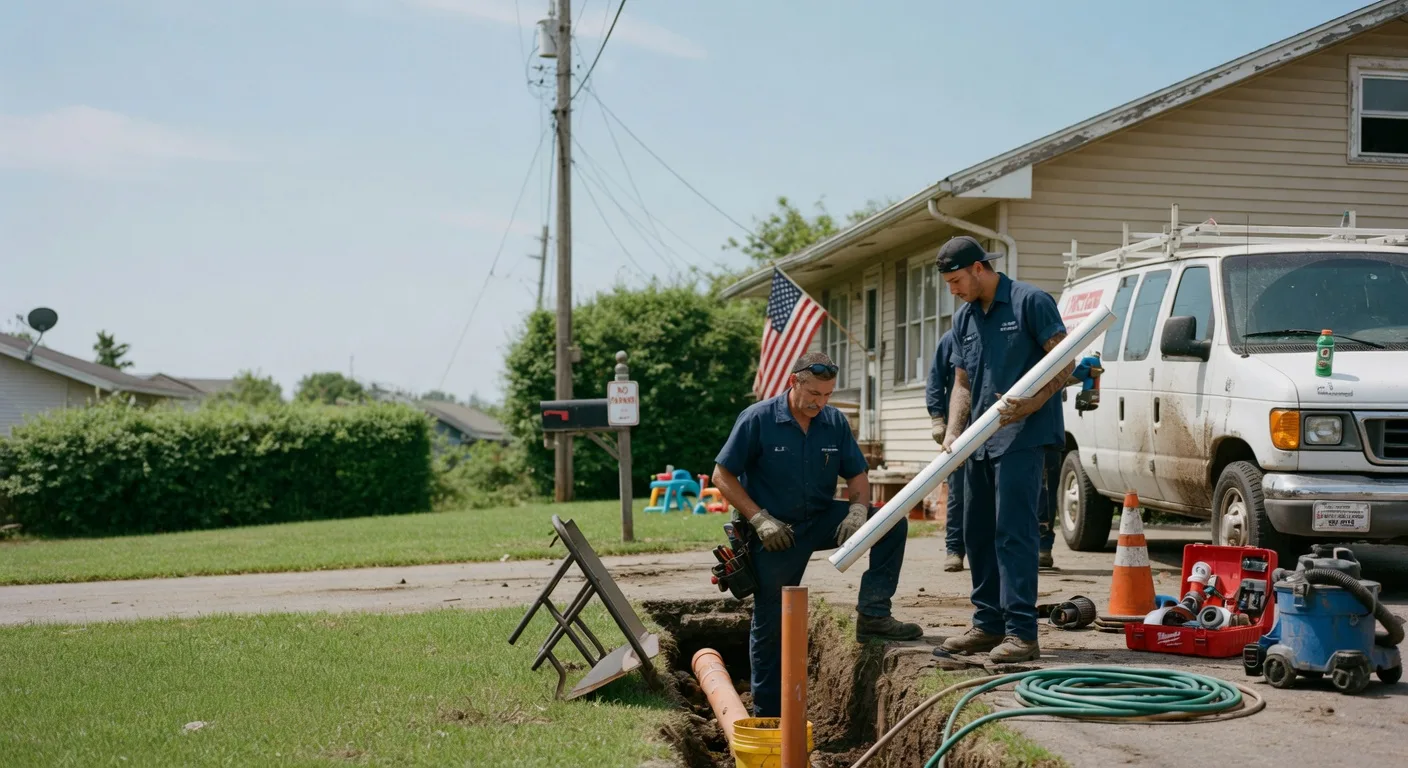
What is a cleanout and why does the plumber keep asking if I have one?
A cleanout is a capped pipe fitting that gives a plumber direct access to the sewer line. It usually looks like a round plug, three or four inches across, sitting on a short stub of pipe. You will often find one in the basement near the main stack, in a crawlspace, along an outside wall or in the yard near the foundation.
The plumber asks because it decides how the job is done. With a cleanout, a cable machine or hydro jetter goes straight into the line. Without one, the equipment has to go in through a toilet, a floor drain or the roof vent. That can mean pulling a toilet, and it limits how far the machine travels and how well a camera can see.
Safe homeowner check: find the cap and note where it is. Do not unscrew it if the house drains are backed up. Water can be standing behind the cap, and it will come out.
Stop running water and call now if the cleanout is wet or leaking, or if several drains in the house are backing up together. That points to a blockage in the main line.
If your home has no cleanout, adding one is often part of the job. What it costs depends on access, how deep the line is, how much has to be dug or cut open, and whether a permit applies.
Expert Plumbers Co is a referral service. Call (380) 262-9173 and we will connect you with a plumber serving Warren Center, PA for Drain Cleaning.
A few practical points help when a cleanout is involved. The cap can be stuck from years of rust or paint, and forcing it with a long wrench can crack the fitting, so leave a stubborn one to the plumber. Keep the area around it clear of storage, snow, soil or landscaping so the crew can reach it quickly. In older homes the cleanout may have been buried when the yard was regraded, or covered by a patio or flooring, and finding it can take some probing. Newer homes usually have one near the foundation or at the property line, sometimes with a green or black cap flush with the lawn. If a plumber can find or install one, later cleanings and camera inspections become simpler and less disruptive, because the equipment enters the line at a planned point and nothing indoors has to be disturbed or removed.
What does it mean if the cable machine stops at the same distance every time?
The cable stops dead at the same spot every time, and the plumber says it feels like a wall. That tells you the problem is fixed in one place. It is not a soft blockage that moves.
Common causes are tree roots that have grown in at a clay pipe joint, a section that has dropped or cracked, or a bellied line where the pipe sags and holds water. It can also be a bad coupling where one pipe no longer lines up with the next. A cable can punch through roots or grease, but it cannot get past a pipe that has shifted or broken.
Note the distance the cable went in. That number tells the next plumber where to look, and whether the fault is inside the house or out in the yard.
Safe homeowner check: if only one fixture is slow, go easy on water and note which drain it is. Stop running water and call now if several drains back up, if water comes up in a tub or floor drain, or if there is a sewage smell indoors.
A camera inspection is the right next step, because it shows what the cable hit. Roots or heavy grease may clear with hydro jetting. A broken or bellied pipe is a repair, and the cost depends on access, how much has to be dug or opened, the materials, and any permit required. Expert Plumbers Co is a referral service. Call (380) 262-9173 and we will connect you with a plumber in Warren Center, PA for Drain Cleaning.
Mark the spot where the stoppage sits if the cleanout or access point makes that possible, and tell the plumber whether the line runs under a slab, a driveway or a lawn. That decides how the repair is approached and how much has to be opened up. In older homes, the stoppage is often a clay joint that has been invaded by roots or has slipped, and the fix may be a spot repair on one section instead of replacing the whole run. In newer homes a stop at the same distance is more often a poorly set joint or a fitting that was installed out of line. After the camera has found the fault, ask for the footage or a few stills. They show the pipe material, the condition on either side of the problem and whether other weak points are coming. Until the repair is done, expect the line to clog again, so keep water use low and avoid putting anything but waste and paper into it.
The house has old galvanized steel drain lines. Why do they keep clogging, and what can cleaning fix?
Galvanized steel was used for drains in older houses, and it ages badly. The zinc coating wears off, the steel underneath rusts, and the inside wall turns rough and flaky. Rust scale builds up in layers, so the pipe gets narrower every year. Hair, soap and grease catch on that rough surface much more easily than on smooth plastic.
That is why you may see slow drains that clear for a few weeks and then slow down again. Threaded joints and fittings also form ledges where debris collects, and horizontal runs with little fall hold water and silt.
What cleaning can do: a cable machine can open a clog and scrape some loose scale off the wall. Hydro jetting can strip more of the buildup and restore much of the bore, as long as the pipe is still sound. A camera look first shows how thick the scale is and whether the steel is thinning.
What cleaning cannot do: it cannot make a worn pipe new. Rust scale can be holding a weak spot together, and aggressive cleaning of a pipe that is corroded through can open a leak or let a section collapse. A pipe that has pinholes, rusted fittings or wet stains at the joints is near the end of its life, and clearing it again and again is a short-term answer.
Do not use chemical drain cleaners on old steel. They sit in low spots and speed up the damage, and they are a hazard for whoever opens the line afterward.
A safe check: look in the basement or crawlspace for rust streaks, flaking, drips or damp spots on the drain pipes. If you see them, or if every fixture on the same stack runs slowly, tell the plumber what you found.
If a section is too far gone, the usual choices are to replace the worn runs with modern pipe or, for some lines, to line them. Cost depends on how much pipe is involved, how easy it is to reach, whether walls or floors must be opened, the materials, and local permit rules.
Expert Plumbers Co can connect you with an independent plumber in Warren Center, PA for this: call (380) 262-9173.
Our cabin or second home sat empty for months and now the drains smell and run slowly. Why?
You open the cabin for the first time in months and the drains smell like a sewer and the water creeps away.
Every fixture has a trap, the curved section that holds a little water to block sewer gas. With no use, that water evaporates. Once the seal is gone, gas comes straight up the drain. The film left in the pipe also changes while the house sits. Soap, grease and food residue dry and harden on the pipe wall, so the first heavy use narrows the line and water slows down. Then there is the line itself. A vacant house can still have roots working into a clay or cast iron joint, and nobody was flushing them back with daily flow.
If one sink or tub is slow and the others are fine, the problem is probably local to that fixture, its trap or its branch line. If every drain is slow, several fixtures gurgle, or the toilet bubbles when you run the washer, the blockage is further down, in the main line or the lateral to the street.
Safe homeowner check: run water in every fixture for a couple of minutes, including rarely used ones, to refill the traps. Pour a cup of water into floor drains. If the smell fades and the flow picks up after a day or two of normal use, dried traps and loosened residue were likely the whole story.
Stop running water and call now if wastewater comes up in a tub, shower or floor drain, if the toilet will not clear, if the smell stays strong after the traps are filled, or if you see wet floors, stained ceilings or sagging drywall.
A cable machine is enough when the clog is residue or a soft plug in one branch. If the line stays slow after cabling, if roots are suspected, or if grease has coated the full pipe wall, the plumber will usually recommend hydro jetting, which scours the pipe wall with high pressure water. A camera inspection settles the question of roots, a belly holding water, or a failed lateral.
Expert Plumbers Co is a referral service. We connect you with an independent local plumber in Warren Center, PA. Call (380) 262-9173.
Before you book, tell the plumber how long the house sat empty, whether it was winterized, and which drains are affected. Ask whether they plan to cable, jet or run a camera first, and what they will do if the camera shows roots or a damaged section. The scope depends on access to the line, the parts or pipe needed, how much has to be opened up, and whether a permit or code step applies to a repair.
Our walk-in shower has a long linear drain and it keeps backing up. Why?
Your walk-in shower has that long, slim linear drain along one wall or the back edge, and it keeps backing up. The water rises around your feet, drains slowly, then does it again a week later. There are a few reasons a linear drain behaves this way.
The channel is long and shallow, so it collects hair and soap scum along its whole length. Many linear drains also have a small outlet at one end or in the middle, often undersized compared to the flow from a large shower head. If the pan is built with a low slope toward the drain, water crawls instead of running, which leaves scum behind and lets hair settle. Under the cover, the trap or the first section of pipe can also fill with hair, so the channel looks clean and still backs up.
If only the shower backs up and the sink and toilet in the same bathroom are fine, the problem is the channel, its outlet, the trap or the shower branch. If other fixtures are slow or gurgling, or water shows in a floor drain, the line further down is involved.
Safe homeowner check: lift out the grate or cover and clean the channel with gloves. Look at how water moves across the floor, because standing water on the pan suggests a slope problem rather than a clog alone. Skip chemical openers.
Stop running water and call now if sewage or gray water comes up elsewhere, if you see moisture on the ceiling or walls below the shower, if the floor around the shower feels soft, or if a sewer smell comes with the backups. A leaking pan is a different problem from a clog and can damage the structure.
A cable machine is usually enough for hair and soap in the trap or short branch, though the plumber must be able to get past the channel outlet. If the problem keeps coming back, a camera inspection can show a belly, offset or roots beyond the shower. Hydro jetting may be proposed when the pipe wall is coated with grease or scale.
Expert Plumbers Co is a referral service. We connect you with an independent local plumber in Warren Center, PA. Call (380) 262-9173.
Ask the plumber whether the cause is the drain body, the slope of the pan or the pipe beyond it. If the slope or outlet is the problem, ask what it takes to correct it. The scope depends on access to the drain, the parts or materials needed, how much tile or floor has to be opened up, and any permit or code requirement.